Automated Export License Tracking: Simplifying International Trade Compliance
The manually-intensive and oftentimes error-prone process of managing export licenses can significantly hinder the efficiency and accuracy of international trade operations. However, with the advent of automation technology, companies can now streamline their export license tracking processes and enhance compliance with regulations. In this article, we will delve into the world of automated export license tracking, exploring its benefits, key tools, and industry applications.
The Importance of Automated Export License Tracking
Export license tracking is a critical component of international trade operations. With trade sanctions and regulations evolving constantly, companies need to ensure that they are compliant with all relevant laws and regulations. Automated export license tracking software simplifies this process by providing real-time updates, alerts, and visibility over the entire export license lifecycle.
Benefits of Automated Export License Tracking
Streamlined Processes: Automated export license tracking software minimizes manual errors and automates routine tasks, freeing up resources for more strategic activities.
Compliance with Regulations: Companies can ensure that they are in compliance with all relevant laws and regulations, reducing the risk of fines and penalties.
Improved Visibility: Automated export license tracking provides real-time updates and visibility over the entire export license lifecycle, enabling companies to make informed decisions.
Enhanced Productivity: By automating routine tasks, companies can improve productivity and increase efficiency, allowing them to focus on high-value activities.
Key Tools for Automated Export License Tracking
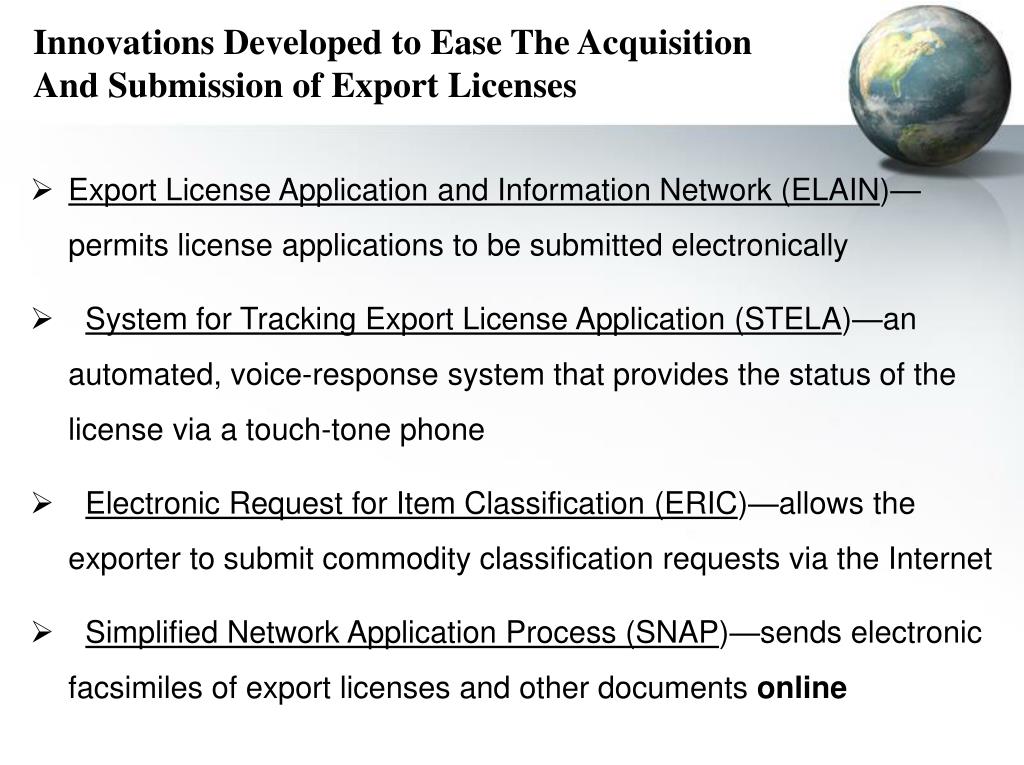
SNAP-R: A web-based system that enables users to submit and track export license applications, commodity classification requests, re-export license applications, and license exception agricultural commodity (AGR) notifications online.
Automated Export System (AES): A joint venture between CBP, the Foreign Trade Division of the Bureau of the Census (Commerce), the Bureau of Industry and Security (Commerce), the Directorate of Defense Trade Controls (State), other federal agencies, and the export trade community. AES is an electronic filing system that requires importers and exporters to provide detailed information about their shipments.
Descartes OCR Global EASE: A platform that enables companies to manage export workflows, automate documents, track shipments, ensure compliance, and streamline operations globally.
Remindax: A system that simplifies license compliance management by providing real-time tracking, validation, and renewal of export licenses.
Industry Applications of Automated Export License Tracking
Automated export license tracking is not only essential for companies engaged in international trade but also for industries such as:
Manufacturing: Companies in the manufacturing sector need to ensure that they are compliant with export regulations and license requirements.
Pharmaceuticals: Pharmaceutical companies need to comply with regulations related to the export of controlled substances and equipment.
Technology: Companies in the technology sector need to comply with regulations related to the export of sensitive technology and software.
Conclusion
Automated export license tracking is a critical component of international trade operations. By implementing automated export license tracking software, companies can streamline processes, improve compliance with regulations, and enhance productivity. With the right tools and industry applications, companies can navigate the complex world of export regulations with confidence and precision.